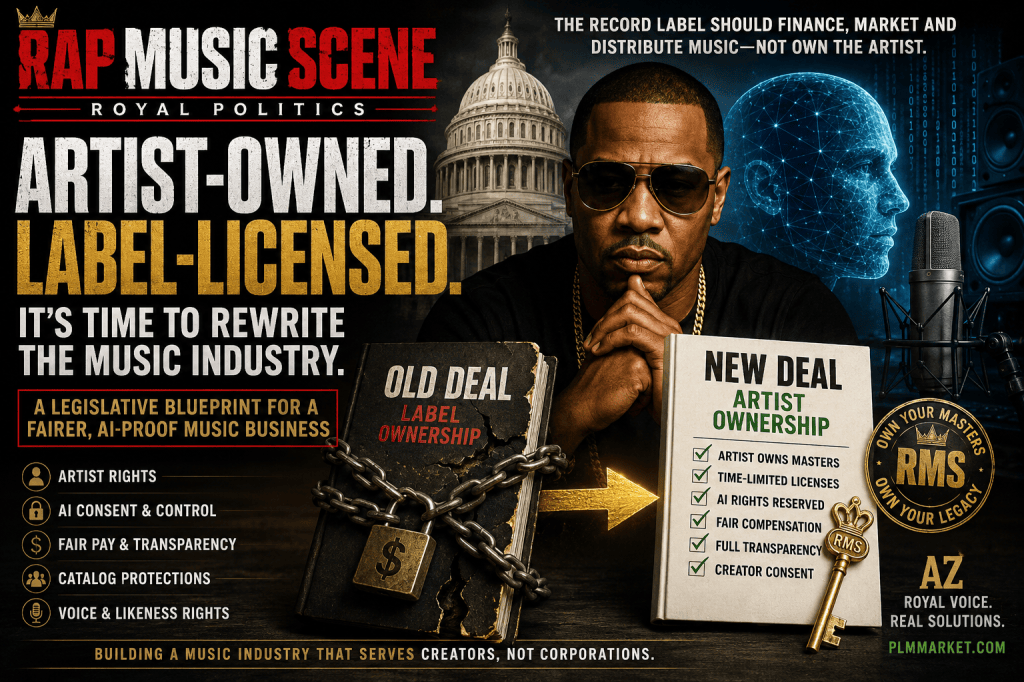
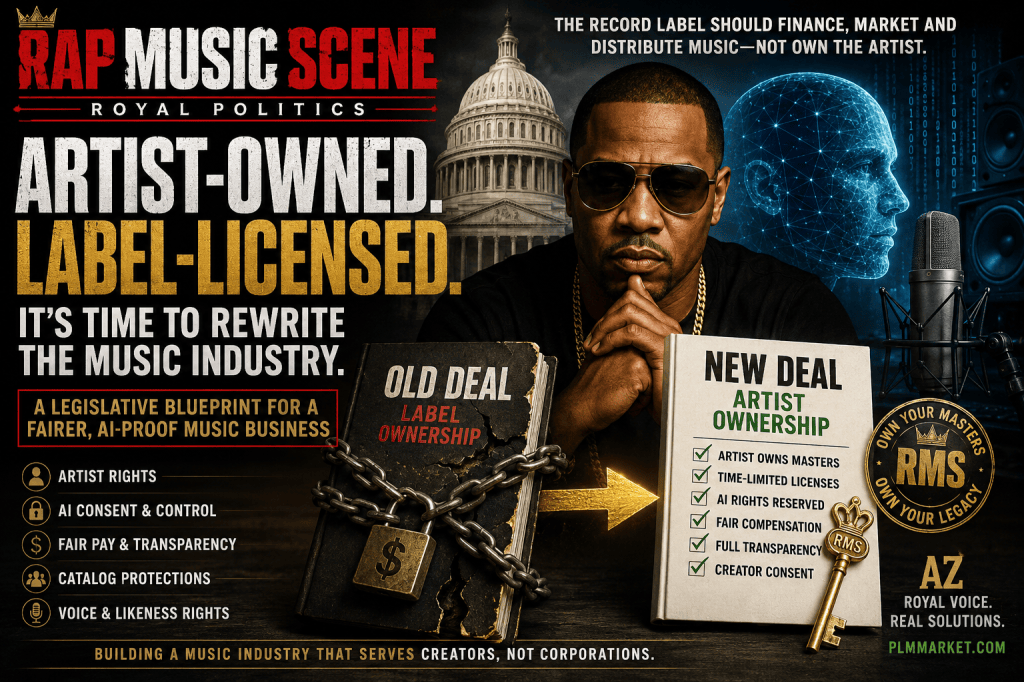
The record label should finance, market and distribute music—not permanently own the artist’s voice, masters, identity and future machine-generated output.
Hip-Hop legend AZ recently described artificial intelligence as a system that has been feeding on artists’ “thoughts,” “stories,” “lyrics” and “legacy” without paying them. His response was not merely to complain. He joined PLMMarket as a founding partner and part-owner, supporting a model in which creators maintain identifiable, monetizable control over the knowledge placed into an AI system. PLMMarket describes its Professional Language Models as creator-authored knowledge bases through which experts can earn subscription, query and participation revenue. (AllHipHop)
AZ’s move raises a larger political question:
Who should possess the legal authority to approve, deny and profit from the use of an artist’s work in the AI economy?
Under the traditional recording-industry structure, the answer may not be the artist. A record label, investment company or catalog purchaser may control the master recording even though the artist supplied the voice, performance, identity and cultural value.
That arrangement was already unfair before generative AI. Now it is dangerous.
A master is no longer valuable only because people can stream, purchase, sample or place the recording in a film. A catalog can potentially be analyzed, separated into stems, used to evaluate consumer behavior, licensed for machine learning, incorporated into a generative model or connected to a synthetic voice and digital replica.
Congress should therefore establish a new legal foundation for the American music industry:
The artist owns the master. The label receives a limited commercial license. AI rights remain with the creator unless separately and specifically authorized.
That is the artist-owned, label-licensed model.
The difference between creating music and controlling music
Copyright law recognizes a musical composition and a sound recording as two separate works. The composition consists of the music and lyrics. The sound recording—commonly called the master—is the fixed recording of a particular performance. These two assets can be owned and licensed separately. (U.S. Copyright Office)
The problem is that current law allows ownership rights to be transferred. It also recognizes works made for hire, under which the hiring or commissioning party may be treated as the legal author and copyright owner rather than the people who physically performed or produced the recording. (U.S. Copyright Office)
The Copyright Office itself explains that performers and producers generally create sound recordings, but a record label can be named as the copyright claimant when it has acquired all the exclusive rights that initially belonged to the authors. (U.S. Copyright Office)
That legal structure allows a person to spend years creating a culturally important body of work while another entity holds the ultimate authority over the resulting recordings.
The public usually sees the artist.
The law often sees the asset owner.
AI makes that division impossible to ignore.
Taylor Swift is the case study—not the exception
Taylor Swift’s fight over her first six albums demonstrates why contractual bargaining alone cannot protect the average artist.
Swift wrote in 2025 that she had spent approximately 20 years hoping for an opportunity to own her life’s work. She re-recorded four albums, mobilized one of the world’s most powerful fan bases and eventually generated enough leverage to purchase her original masters. Only then could she announce that all the music she had made belonged to her. (The Official Website of Taylor Swift)
Her victory was extraordinary precisely because the necessary resources were extraordinary.
Most rappers cannot finance the reconstruction of several albums. They cannot redirect billions of streams toward replacement recordings. They cannot generate the bargaining power of a worldwide stadium tour and then purchase a catalog valued in the hundreds of millions of dollars.
The lesson should not be that every artist must become Taylor Swift before earning control over their own work.
The lesson should be that the law placed ownership on the wrong side of the relationship from the beginning.
Swift should not have needed to buy her musical life back. Neither should any other artist.
Why AI changes the meaning of master ownership
The U.S. Copyright Office says modern generative systems are developed using massive quantities of data that include copyrighted works. It recognizes the concern that artists’ complete bodies of work could be used against their wishes to produce new content that competes with them. (U.S. Copyright Office)
The Office has also documented an emerging market for voluntary AI-training licenses, particularly in industries such as popular music where concentrated bodies of valuable content can be licensed in volume.
That creates a serious structural problem.
Suppose a label controls thousands of commercially successful master recordings. The label may be positioned to negotiate a catalog-wide AI agreement because it owns or controls the recordings.
But the featured artists supplied the voices.
Songwriters supplied the lyrics and compositions.
Producers created the sonic architecture.
Session musicians supplied performances.
Fans supplied the listening behavior that revealed which creative patterns were most commercially effective.
The corporation may nevertheless become the primary negotiating party.
The master owner can potentially monetize the catalog again—not merely as recorded entertainment, but as machine-readable productive infrastructure.
The catalog becomes a dataset.
The dataset becomes a model.
The model produces future commercial material.
And the people who created the source material may be reduced to contractual royalty participants—or excluded entirely—depending on agreements they signed before modern generative AI existed.
That cannot remain the default.
The proposed Artist Ownership and Music Licensing Act
Congress should enact an Artist Ownership and Music Licensing Act, establishing minimum national rights for recording artists, producers, musicians and songwriters.
The legislation would not abolish record labels. It would redefine their role.
Labels could still finance recording sessions, issue advances, build marketing campaigns, distribute albums, coordinate radio promotion, negotiate partnerships and assume commercial risk.
What they could not do is convert temporary financial support into permanent ownership of an artist’s cultural output.
1. Artists must initially own their masters
Federal law should establish that the featured recording artist and qualifying human co-creators are the initial owners of a newly created sound recording.
A label could obtain an exclusive license, but it could not obtain permanent copyright ownership merely through boilerplate language in a standard recording agreement.
The work-made-for-hire doctrine should not apply to a featured artist’s recording unless the performer is a genuine salaried employee creating music within the ordinary scope of employment—not an independent artist signing a contract after developing a career, identity and audience.
Congress has previously examined the impact of work-made-for-hire treatment on recording artists. The Copyright Office concluded that significant contributors to sound recordings should possess termination rights, while congressional testimony emphasized that termination exists partly to correct the unequal bargaining position of creators who cannot know a work’s future value when signing an initial agreement. (U.S. Copyright Office)
The principle should be simple:
Financing a recording does not make the financier its author.
2. Labels should receive time-limited exclusive licenses
The artist should license specified commercial rights to the label for a defined period.
A standard term might be seven years from the initial commercial release, with any renewal requiring affirmative approval from the artist. California already limits enforcement of many personal-service agreements involving unique or extraordinary services to seven years, although that law does not itself establish master ownership. Congress could use the same general time horizon when constructing a federal recording-license framework. (Legislative Information)
The license could cover:
- commercial distribution;
- streaming and physical sales;
- ordinary promotion;
- approved marketing partnerships;
- specifically defined territories;
- a clearly stated period.
At expiration, the exclusive rights would automatically return to the artist without a lawsuit, termination notice or additional payment.
There should be no perpetual license disguised through automatic extensions, unreasonably delayed delivery requirements or album-option clauses controlled solely by the label.
3. The license must not become ownership through the back door
The law should prohibit agreements that are called licenses but function as permanent transfers.
A label should not be permitted to claim an exclusive license for the entire copyright term, renew the agreement unilaterally or hold the recording indefinitely because some portion of an advance remains unrecouped.
Unrecouped expenses should remain financial obligations governed by the contract. They should not transform into permanent ownership of the artist’s master.
When the license ends, the label’s control ends.
4. AI rights must be legally separate from ordinary music rights
A distribution license should not automatically include AI-training rights.
Neither should a traditional clause covering technologies “now known or later developed.”
Congress should establish AI use as a separate reserved right requiring a distinct written agreement.
That agreement should separately address:
- training and fine-tuning;
- model evaluation and benchmarking;
- stem extraction;
- lyric and composition analysis;
- voice modeling;
- digital replicas;
- style-conditioned generation;
- synthetic performances;
- generated remixes;
- future music created from the model;
- whether the model may be transferred or sublicensed;
- what happens to the model when authorization expires.
A label licensed to distribute an album on Spotify should not automatically have authority to turn the artist’s catalog into a music-generation engine.
5. AI consent must be informed and specific
California has already provided one useful legislative model. AB 2602 makes certain digital-replica provisions unenforceable when the contract lacks a reasonably specific description of the intended use and the individual was not properly represented during negotiations. (Legislative Information)
Federal music legislation should go further.
Consent should be invalid unless the agreement identifies:
- the AI developer;
- the model or system;
- the exact recordings and data involved;
- the intended commercial uses;
- the length of the license;
- the expected output categories;
- compensation;
- sublicensing rights;
- deletion and model-retirement requirements;
- whether the artist may revoke future uses.
The artist should receive independent legal representation before granting digital-replica or AI-training rights.
A signature buried inside a 100-page recording agreement should not qualify as meaningful consent.
6. Voice and likeness rights must remain personal
Owning a master recording should not mean owning the human being whose voice appears in it.
Tennessee’s ELVIS Act expanded state protections covering unauthorized uses of an individual’s voice and likeness. Federal lawmakers also introduced the bipartisan NO FAKES Act in 2025 to create a national right addressing unauthorized digital replicas. (Tennessee State Government)
Those protections should be incorporated into a larger artist-ownership framework.
A label should never be able to argue:
We own the recording, so we can build and operate a permanent simulation of the performer.
A master license and a digital-identity license are different transactions.
The artist’s identity should be nontransferable. Any commercial use of a synthetic voice, face or performance should require specific approval and continuing compensation.
7. Creators must receive direct, nonrecoupable AI revenue
Congress has already accepted direct statutory payments to performers as a legitimate music-industry mechanism. Under Section 114, 45 percent of certain statutory digital-performance receipts are paid to the featured recording artists rather than being routed entirely through the copyright owner. (U.S. Code)
That principle should be extended to AI.
At least 50 percent of gross revenue from an AI license involving music should be paid directly into a human-creator pool. That money should not be reduced by an artist’s unrelated recording advance, marketing debt or tour-support balance.
Regulations could allocate the pool among:
- featured performers;
- songwriters and composers;
- producers;
- nonfeatured vocalists;
- session musicians;
- other documented human contributors.
The remaining percentage would be negotiable among the master owner, publisher, label, AI developer and other participants.
Under the artist-owned model, artists would also negotiate from the stronger position of controlling the underlying master.
8. Artists must be able to approve placements and associations
Ownership is not only about money. It is also about context.
Artists should possess approval rights over uses involving:
- political campaigns;
- weapons;
- gambling;
- alcohol and nicotine;
- military recruitment;
- sexually explicit material;
- synthetic collaborations;
- advertising;
- films and television;
- games;
- brand endorsements;
- controversial AI products.
A label may want the highest licensing fee available. The artist may reasonably decide that a particular use conflicts with their identity, beliefs, community or legacy.
Under artist ownership, that decision belongs to the artist.
9. Catalog licenses should not be freely sold without consent
A label should not be able to sell an artist’s licensing agreement to private equity, an AI company or another record conglomerate without the creator’s knowledge.
The legislation should provide:
- advance notice of any proposed assignment;
- a right of first refusal for the artist;
- the right to reject assignments to AI developers or catalog funds;
- automatic termination when an unauthorized assignment occurs;
- disclosure of the proposed purchaser and transaction terms.
Investors may purchase a label’s revenue interest. They should not automatically acquire personal authority over the artist’s identity, AI rights or approval rights.
10. Recoupment must be transparent and limited
The artist-owned model must also address accounting.
Labels should be required to provide clear quarterly statements showing:
- gross revenue by source;
- platform and distributor deductions;
- approved recording expenses;
- marketing expenditures;
- recouped and unrecouped balances;
- licensing income;
- foreign receipts;
- reserves;
- related-party charges;
- AI-related revenue.
Ordinary corporate overhead, executive salaries, unrelated legal expenses and internal markups should not be charged to an artist’s account unless specifically negotiated and reasonably connected to the project.
Cross-collateralization—using one successful album, song or revenue stream to cover unrelated losses—should require express and separately initialed consent.
Artists should have meaningful audit rights, with the label paying the audit costs when underpayment exceeds a defined threshold.
11. Existing artists need stronger reversion rights
Current federal termination rights generally cannot take effect until approximately 35 years after a grant, and works made for hire are excluded. (U.S. Copyright Office)
Thirty-five years is far too long in a digital market.
For future agreements, Congress should establish automatic reversion after no more than seven years.
For existing catalogs, legislation should provide:
- a new accelerated termination window;
- a right of first refusal before a catalog sale;
- immediate artist consent rights for AI training and digital replicas;
- mandatory disclosure of all AI agreements;
- the ability to terminate a grant when royalties or statements are materially withheld.
Retroactive reform would have to respect constitutional and contractual limits, but Congress does not have to leave creators powerless merely because an old agreement never anticipated generative AI.
At minimum, no existing master owner should be able to claim that a decades-old recording contract silently transferred rights to technologies and commercial uses that did not exist when the artist signed it.
12. Enforcement must be realistic
Rights without enforcement are publicity.
The proposed law should authorize:
- statutory damages;
- recovery of profits;
- attorneys’ fees;
- injunctions;
- model deletion orders;
- dataset removal;
- state attorney-general enforcement;
- Federal Trade Commission enforcement;
- a private right of action;
- anti-retaliation protections;
- personal liability for executives who knowingly conceal AI uses.
The Copyright Office should maintain a searchable public registry of AI music licenses identifying the master owner, participating creators, AI developer, authorization period and permitted categories of use.
Confidential financial terms could remain protected while the existence and basic scope of the license remain public.
How the new model would work
Consider a fictional independent rapper preparing a new album.
| Contract issue | Traditional ownership model | Artist-owned, label-licensed model |
|---|---|---|
| Master ownership | Label may own the master indefinitely | Artist’s LLC owns the master from creation |
| Label rights | Broad ownership or perpetual control | Seven-year exclusive commercial license |
| Advance | Recouped under label-controlled accounting | Recoupment limited to documented, approved expenses |
| Artist income | May begin only after recoupment | Guaranteed first-dollar, nonrecoupable payment |
| AI training | Potentially included in broad exploitation language | Completely excluded unless separately authorized |
| Voice clone | Potential contractual ambiguity | Separate personal consent required |
| Catalog sale | Label may sell controlled asset | Artist notice, consent and first-refusal rights |
| License expiration | Ownership may remain with label | Rights return automatically to artist |
| Future exploitation | Label continues monetizing catalog | Artist chooses a new label, distributor or direct model |
A sample deal could operate as follows:
The artist’s company owns the master. A label provides a $500,000 recording and marketing commitment. In exchange, the label receives a seven-year exclusive worldwide distribution and marketing license.
The artist receives a minimum percentage from the first dollar, regardless of recoupment. The label recovers only documented, contractually approved costs. After recoupment, the parties divide revenue according to their negotiated percentages.
The artist retains approval over synchronization, political use, advertising, sampling, catalog assignment and synthetic performances.
AI rights are not part of the original agreement.
Should an AI developer later offer $10 million to train a model on the album, the artist decides whether the proposal is accepted. Songwriters, producers and performers receive direct compensation. The model’s permitted uses, duration and deletion obligations are written into a separate agreement.
When the seven-year label license expires, the artist remains the owner.
The label has been compensated for its investment and services. The artist retains the permanent asset.
That is a legitimate partnership.
This model does not eliminate labels
Record companies will argue that ownership compensates them for risk.
But investment does not automatically require permanent copyright ownership.
A lender can receive repayment.
An investor can receive profit participation.
A distributor can receive a fee.
A marketing partner can receive a revenue percentage.
A label can receive an exclusive license and priority recoupment.
None of those arrangements require the company to own the artist’s master for the entire copyright term.
Labels that genuinely create value would remain valuable. They would compete for licenses by offering better financing, marketing, strategy, transparency and international reach.
Labels that depend primarily on capturing permanent ownership from inexperienced creators would face pressure to change.
That is precisely the point.
Why this matters most to Hip-Hop
Hip-Hop has generated enormous economic value while repeatedly teaching artists that ownership is something to pursue only after becoming successful.
That sequence is backward.
Artists are often asked to surrender ownership before anyone knows how valuable the music will become. If the record fails, the company writes it off. If the record becomes culturally historic, the company owns a long-term asset whose value may continue growing for generations.
AI raises the stakes because the company may no longer be monetizing only the old song.
It may be monetizing what can be extracted from the song:
- the voice;
- flow patterns;
- lyrical structures;
- production techniques;
- audience data;
- emotional categories;
- stylistic relationships;
- synthetic derivatives;
- future machine-generated recordings.
Hip-Hop artists should not become raw material for automated replacements controlled by the same institutions that already control their masters.
Congress must decide who the music economy is built to serve
The old record contract treated the artist as a temporary source of labor and the master as a permanent corporate asset.
The AI economy can make that imbalance worse. A company that controls a catalog may seek to control not only the recordings that already exist, but also the synthetic output that can be derived from them.
Legislation must establish a different order:
The human creator is the principal.
The label is the commercial partner.
The master remains with the artist.
AI use requires separate consent.
Revenue follows the people whose work powers the system.
AZ’s creator-ownership move points toward the correct principle: people should not have to surrender their knowledge, work or identity in exchange for access to technology.
The music industry should operate the same way.
Labels should not own artists.
Labels should not own voices.
Labels should not control digital replicas.
And labels should not permanently possess the cultural property artists create simply because they financed one stage of its commercial release.
The future should be artist-owned and label-licensed.
Anything less allows the music industry to turn human legacies into corporate training data—and call it innovation.