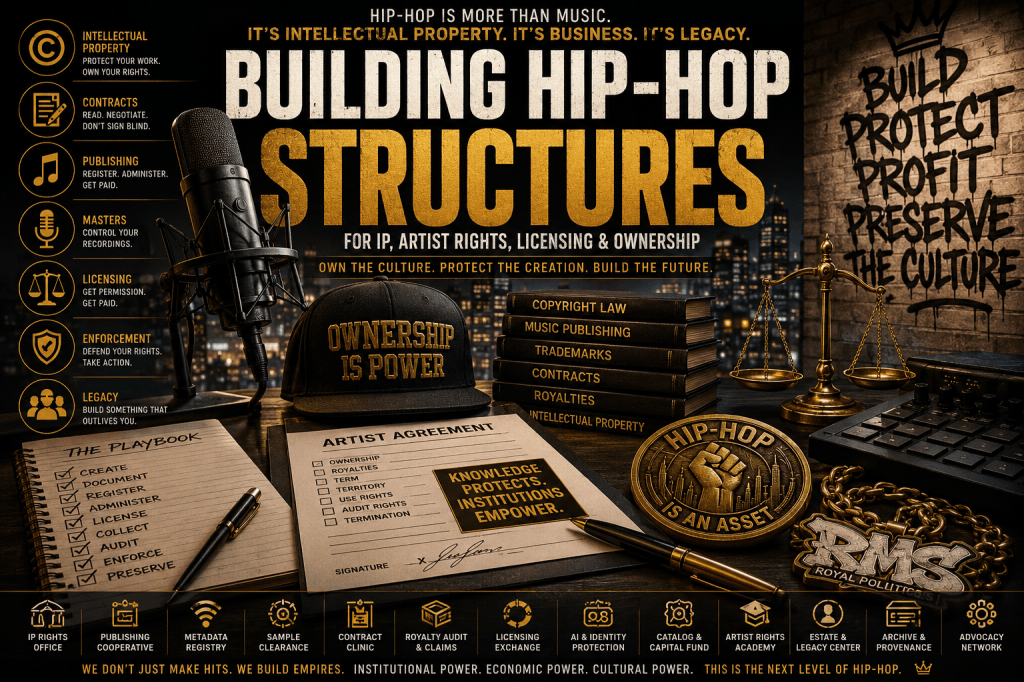
Hip-hop has already proven that it can create global culture. The next stage is building the institutions that protect, administer and expand the value created by that culture.
Hip-hop does not suffer from a shortage of talent.
It does not lack influential artists, producers, writers, engineers, photographers, designers, filmmakers, managers or entrepreneurs. It has repeatedly transformed music, language, fashion, advertising, technology and popular culture.
The structural weakness appears after the creation occurs.
Who documents the ownership?
Who registers the rights?
Who reviews the contract?
Who administers the publishing?
Who clears the sample?
Who collects the royalties?
Who monitors the license?
Who audits the distributor?
Who protects the artist’s name, voice and likeness?
Who preserves the catalog when the artist dies?
Who negotiates with technology companies when a new platform begins extracting value from hip-hop?
For too long, the culture has produced intellectual property faster than it has built institutions capable of protecting and administering that intellectual property.
The next stage of hip-hop development must therefore move beyond encouraging artists to “learn the business.”
Individual education is necessary, but an industry cannot depend on every young artist independently becoming a copyright attorney, accountant, metadata specialist, publishing administrator, licensing executive and estate planner.
Hip-hop needs infrastructure.
Popularity Is Not Ownership
One of the music industry’s greatest illusions is the idea that visibility automatically produces power.
An artist can have:
- millions of streams;
- viral records;
- major media attention;
- influential style;
- recognizable lyrics;
- cultural credibility;
- and a large audience;
while possessing limited control over the underlying intellectual property.
Fame measures public recognition.
Ownership determines who controls the asset.
Administration determines whether the owner is identified and paid.
Licensing determines how the asset may be used.
Accounting determines whether the money reaches the correct party.
Enforcement determines whether those rights mean anything when challenged.
A serious hip-hop infrastructure must connect all of these functions.
Understanding the Two Core Music Copyrights
A commercially released song commonly involves at least two distinct copyrighted works:
- The musical work, meaning the composition—the underlying music and lyrics.
- The sound recording, meaning the particular recorded performance of that composition.
The songwriter or publisher may control the composition, while an artist, independent label or record company may control the sound recording. In some cases, the same person or company owns both. In others, ownership is divided among multiple parties. (U.S. Copyright Office)
This distinction affects nearly every part of the music business.
A film producer seeking to use a released song may need permission involving both the composition and the master recording. A songwriter may be owed one category of royalties while the sound-recording owner is owed another. An artist who performed a record may not own either underlying copyright unless the governing agreements say otherwise.
That is why saying, “I made the song,” is not a complete rights analysis.
The important questions are:
- Who wrote the composition?
- Who owns each writer’s share?
- Who administers those shares?
- Who financed and owns the master?
- Was the recording created as a work made for hire?
- Were any samples or interpolations used?
- What rights were assigned or licensed?
- Which companies are authorized to collect the resulting revenue?
Hip-hop must build institutions capable of answering these questions before disputes begin.
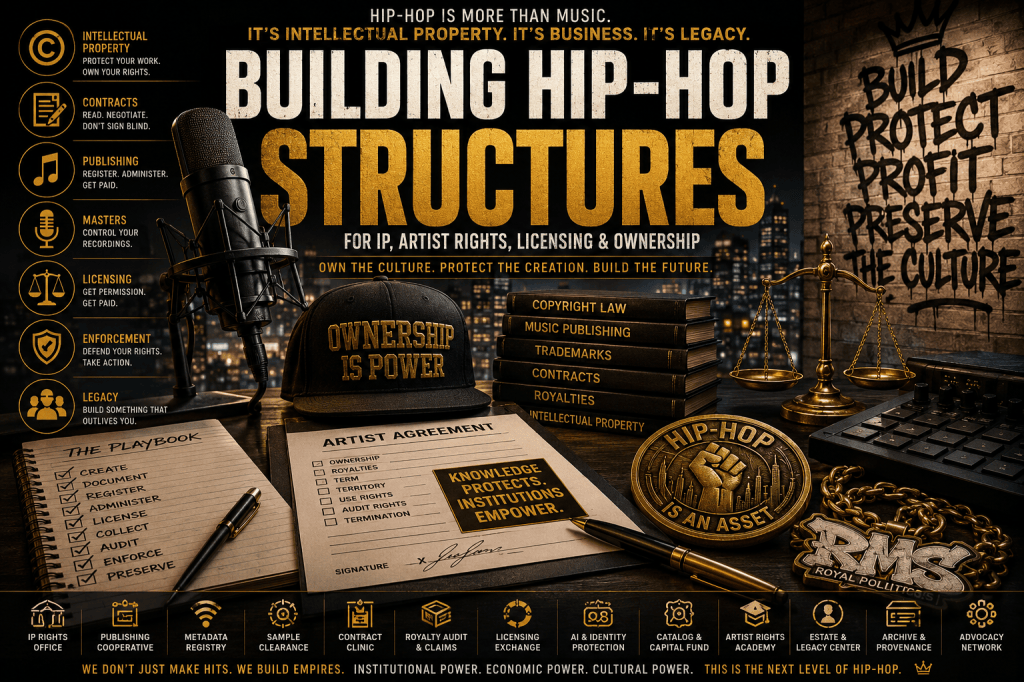
1. The Hip-Hop Intellectual Property Rights Office
The Hip-Hop Intellectual Property Rights Office would serve as a central educational and administrative institution for creators and independent companies.
Its purpose would be to help artists understand, document and protect the assets they create.
Core Functions
The office could provide structured guidance involving:
- copyright ownership;
- trademark protection;
- publishing rights;
- master ownership;
- producer agreements;
- featured-artist agreements;
- split sheets;
- work-for-hire provisions;
- licensing;
- merchandising;
- name, image and likeness rights;
- digital replicas;
- and catalog succession.
It would not replace individualized legal representation. Instead, it would create an accessible first layer of institutional knowledge, documentation and professional referral.
Rights Inventory
Every participating artist or company should be able to build a private rights inventory containing:
- legal names and professional names;
- company ownership information;
- song titles;
- alternative titles;
- writers and ownership percentages;
- producer credits;
- performing artists;
- master owners;
- publishers and administrators;
- registration numbers;
- unique recording and composition identifiers;
- distribution agreements;
- licenses;
- sample-clearance documentation;
- artwork rights;
- video rights;
- trademarks;
- and royalty accounts.
This inventory would function as the artist’s intellectual-property ledger.
The goal is simple:
Every asset should have an identifiable owner, supporting documentation and an administration path.
2. The Hip-Hop Publishing Administration Cooperative
Many artists understand that publishing matters without fully understanding what publishing administration requires.
A publishing administration cooperative could help independent writers and producers properly register works, maintain ownership data, issue licenses, monitor usage and collect eligible revenue.
Why Administration Matters
Owning a percentage of a song does not automatically guarantee that every relevant organization has accurate information about that ownership.
Composition information may need to be submitted to several institutions depending on the rights and uses involved. The Mechanical Licensing Collective administers the United States blanket mechanical license for eligible interactive streaming and download services. Digital service providers operating under that license send usage data and royalties to The MLC, which then distributes eligible royalties to registered and identified rightsholders. (themlc.com)
A writer may also need relationships with a performing-rights organization, a publishing administrator or other collection entities depending on territory and revenue type.
The cooperative could help creators understand that:
- copyright registration is not the same as royalty registration;
- a performing-rights organization does not necessarily collect every category of music revenue;
- a distributor does not automatically administer publishing;
- and a record label’s accounting does not necessarily cover money owed directly to songwriters or performers by other organizations.
Cooperative Services
The organization could provide:
- composition registration;
- split confirmation;
- conflict identification;
- publisher account administration;
- royalty statement review;
- international collection coordination;
- catalog reconciliation;
- ownership-change processing;
- and unmatched-work research.
Its purpose would not be to seize publishing from artists.
Its purpose would be to help artists retain publishing while gaining the professional administration required to make ownership functional.
3. The Master Ownership and Metadata Registry
Hip-hop needs a trusted system for preserving information about sound recordings.
Every completed recording should be connected to verified information about:
- the featured artist;
- nonfeatured performers;
- producer;
- executive producer;
- sound-recording owner;
- label;
- distributor;
- recording date;
- release date;
- territory;
- unique recording identifier;
- samples;
- featured appearances;
- producer points;
- and royalty instructions.
Metadata Is Economic Infrastructure
Metadata may appear technical, but it is directly connected to attribution, discovery, licensing and payment.
A record can travel across streaming services, social platforms, radio systems, games, films and international markets. When ownership and contributor data are missing or inconsistent, the people who created the asset may become harder to identify and pay.
The registry would not replace official registration or collection systems. It would provide an independent internal record that creators could use to verify what outside platforms and companies report.
A Hip-Hop Credits Standard
The registry could establish a culture-wide credits standard requiring releases to document:
- all writers;
- producers and coproducers;
- engineers;
- mixers;
- featured and supporting performers;
- musicians;
- sample sources;
- artwork creators;
- video directors;
- and ownership entities.
Hip-hop should not accept a digital marketplace where the song is globally available but the people who made it remain invisible.
Credits are not merely ceremonial.
Credits are ownership evidence, career history and economic data.
4. The Sample Clearance and Licensing Center
Sampling is one of hip-hop’s foundational creative technologies.
It is also one of its most complicated rights environments.
A Hip-Hop Sample Clearance and Licensing Center could help artists, producers, labels and legacy rightsholders identify sampled works, locate relevant owners, negotiate permissions and document approved uses.
Core Services
The center could assist with:
- sample identification;
- composition ownership research;
- master ownership research;
- interpolation analysis;
- clearance requests;
- fee and royalty negotiations;
- limited-use licenses;
- archival documentation;
- and replacement strategies when clearance cannot be obtained.
The center could also build relationships with legacy artists, estates, publishers and labels to create more predictable pathways for licensing older music.
From Conflict to Marketplace
Instead of treating every sample as the beginning of a lawsuit, hip-hop could build a marketplace where creators and rightsholders can find one another earlier.
A structured system could allow rightsholders to establish:
- preferred licensing terms;
- works available for sampling;
- restricted works;
- standard information requirements;
- review procedures;
- and contact channels.
Not every sample can or should receive automatic approval. But the process should not remain unnecessarily inaccessible, slow or dependent on private industry relationships.
Sampling created enormous cultural value.
Hip-hop should build the infrastructure through which that value can be lawfully shared.
5. The Artist Contract and Rights Clinic
Many damaging music agreements are signed when the artist has the least leverage, the least information and the greatest urgency.
The Artist Contract and Rights Clinic would provide independent education and access to qualified attorneys before creators sign agreements.
Agreements Requiring Review
The clinic could address:
- recording contracts;
- distribution agreements;
- producer agreements;
- management agreements;
- publishing agreements;
- administration agreements;
- featured-artist releases;
- work-for-hire contracts;
- beat licenses;
- merchandising agreements;
- brand partnerships;
- sponsorships;
- synchronization licenses;
- touring agreements;
- and catalog-sale agreements.
The Structural Questions
Rather than focusing only on the advance, the clinic would teach artists to examine:
- the length of the agreement;
- options and renewal rights;
- ownership;
- exclusivity;
- accounting;
- recoupment;
- controlled-composition provisions;
- royalty definitions;
- cross-collateralization;
- audit rights;
- approval rights;
- termination;
- name and likeness rights;
- re-recording restrictions;
- artificial-intelligence provisions;
- and dispute procedures.
An advance is not the full value of an agreement.
It may be a payment against future earnings, a transfer of risk, a method of securing control or a combination of all three.
Artists need advisers who can explain what the company receives—not only what the artist receives on signing day.
6. The Hip-Hop Royalty Audit and Claims Unit
An ownership system without accounting and enforcement is incomplete.
The Royalty Audit and Claims Unit would help creators determine whether usage information, ownership records and payments are accurate.
Revenue Areas
The unit could review:
- distributor statements;
- label royalties;
- producer royalties;
- publishing income;
- mechanical royalties;
- performance royalties;
- neighboring rights;
- synchronization payments;
- merchandise participation;
- social-platform revenue;
- user-generated-content claims;
- and international collections.
SoundExchange administers United States statutory digital-performance royalties for sound recordings used by eligible noninteractive digital services, including services such as Pandora and SiriusXM. Featured artists and sound-recording owners generally must register and claim their recordings to receive applicable payments. (SoundExchange)
That is one example of why artists need a revenue map. Different organizations administer different rights, and one registration does not automatically activate every possible payment stream.
Claims and Reconciliation
The unit could help resolve:
- missing recordings;
- conflicting ownership claims;
- incorrect writer shares;
- duplicate registrations;
- unpaid producer royalties;
- unidentified works;
- unclaimed accounts;
- and inconsistent statements.
It could also develop independent auditing capacity for artists whose agreements provide audit rights.
The objective is not to encourage baseless accusations.
The objective is to ensure that contractual and statutory rights can be verified.
7. The Hip-Hop Licensing Exchange
Hip-hop intellectual property should not become valuable only when an outside advertising agency, film studio or technology company decides to use it.
The culture needs its own licensing infrastructure.
The Hip-Hop Licensing Exchange could connect verified rightsholders with legitimate opportunities in:
- film;
- television;
- advertising;
- video games;
- sports;
- documentaries;
- trailers;
- fashion;
- museums;
- podcasts;
- educational media;
- public exhibitions;
- and digital platforms.
A Searchable Licensing Catalog
Rightsholders could identify works according to:
- genre;
- era;
- mood;
- lyrical themes;
- tempo;
- instrumental availability;
- clean versions;
- ownership status;
- sample status;
- territory;
- and licensing contact.
The exchange would prioritize tracks with documented composition and master ownership so that potential licensees can obtain responses efficiently.
Negotiating Beyond Exposure
Licensing discussions should examine:
- term;
- territory;
- media;
- exclusivity;
- editing rights;
- context;
- promotional use;
- artificial-intelligence use;
- archival use;
- renewal;
- and fee structure.
Exposure is not a substitute for permission or compensation.
A licensing institution would give independent creators a professional route into markets that are often controlled by private networks.
8. The Name, Image, Voice and Digital Replica Protection Lab
Artificial intelligence has made the protection of identity a central artist-rights issue.
An artist’s voice, appearance, performance style and public identity can now be imitated at scale. Unauthorized digital replicas may confuse audiences, interfere with legitimate releases and extract commercial value from the reputation an artist spent years building.
The U.S. Copyright Office has examined digital replicas separately from traditional copyright and recommended federal legislation addressing unauthorized replicas that realistically but falsely depict individuals. Its AI reports also distinguish questions involving digital identity from the copyrightability of AI-generated output. (U.S. Copyright Office)
Lab Functions
The lab could develop:
- identity-rights education;
- voice and likeness licensing standards;
- AI contract language;
- digital-replica monitoring;
- evidence-preservation procedures;
- takedown and dispute support;
- authorized model-training licenses;
- and public verification tools.
Consent Must Be Specific
Artists should not accept vague contract language allowing a company to use their identity through any technology, forever, for any purpose.
Agreements involving AI or digital replicas should examine:
- what data may be used;
- who may use it;
- the permitted purpose;
- whether model training is authorized;
- how long permission lasts;
- whether sublicensing is allowed;
- whether the artist can approve the output;
- how the artist is paid;
- and what happens after termination or death.
Hip-hop should not wait until digital replicas become routine before creating standards.
9. The Independent Catalog and Community Capital Fund
Ownership cannot be protected if artists are repeatedly forced to sell valuable rights during periods of financial pressure.
A Hip-Hop Catalog and Community Capital Fund could provide lawful financing alternatives for artists, producers, labels and estates.
Possible Functions
The fund could support:
- recording budgets;
- marketing;
- touring infrastructure;
- catalog administration;
- litigation costs;
- royalty advances;
- estate stabilization;
- rights reacquisition;
- and independent company growth.
The purpose would not be to eliminate outside investment.
It would be to increase the number of financing options available so that creators are not forced to exchange permanent ownership for short-term survival.
Investment Discipline
Any community capital structure would require:
- securities compliance;
- independent valuation;
- professional underwriting;
- transparent fees;
- conflict-of-interest rules;
- audited financial reporting;
- risk disclosure;
- and qualified management.
Calling capital “community owned” does not remove the need for financial discipline.
The institution must protect both the artist receiving capital and the people whose money supports the fund.
10. The Hip-Hop Artist Rights Academy
The industry often tells artists to read their contracts after presenting them with documents filled with specialized language, compressed deadlines and unequal bargaining power.
The Artist Rights Academy would teach music-business knowledge before the contract arrives.
Core Curriculum
The academy could offer training in:
- copyright;
- trademarks;
- publishing;
- master ownership;
- royalty systems;
- contracts;
- licensing;
- sampling;
- distribution;
- accounting;
- taxes;
- business formation;
- insurance;
- catalog valuation;
- estate planning;
- artificial intelligence;
- and data management.
Different Training Paths
Separate courses could be designed for:
- recording artists;
- songwriters;
- producers;
- managers;
- independent labels;
- engineers;
- DJs;
- photographers;
- filmmakers;
- and heirs managing artist estates.
The academy should use actual documents, simulations and rights-mapping exercises rather than only motivational lectures.
A student might be required to:
- complete a split sheet;
- identify both copyrights in a song;
- read a royalty statement;
- prepare a master metadata sheet;
- evaluate a beat license;
- trace a digital royalty;
- and identify problematic language in a hypothetical agreement.
The purpose is not to turn every artist into an attorney.
It is to ensure that artists know when they need one.
11. The Hip-Hop Estate and Legacy Center
Many catalogs become disorganized after an artist dies or becomes incapacitated.
Family members may inherit valuable rights without receiving the records, passwords, contracts or professional guidance necessary to administer them.
The Hip-Hop Estate and Legacy Center would help creators prepare before a crisis.
Legacy Planning
The center could help artists organize:
- wills and trusts;
- business succession;
- copyright ownership;
- publishing interests;
- master rights;
- trademarks;
- unreleased music;
- royalty accounts;
- social accounts;
- domain names;
- physical archives;
- passwords;
- licensing instructions;
- and authorized representatives.
Estate Support
The center could also assist heirs with:
- ownership verification;
- probate-related referrals;
- royalty registration;
- licensing inquiries;
- catalog preservation;
- counterfeit merchandise;
- unauthorized releases;
- documentary requests;
- and archival partnerships.
Hip-hop has lost too many artists for legacy planning to remain an afterthought.
The culture must protect not only active careers, but the families and institutions that survive them.
12. The Hip-Hop Archive and Provenance Center
Hip-hop history is intellectual property.
Original recordings, notebooks, flyers, photographs, clothing, equipment, contracts, videos, websites and oral histories possess cultural and economic value.
Yet these materials are often discarded, scattered or acquired by outside institutions after the people closest to the culture fail to preserve them.
The Archive and Provenance Center would document:
- who created an object;
- who owns it;
- when it was created;
- where it appeared;
- how it was acquired;
- and what rights accompany it.
Preservation and Control
The center could establish:
- digital archives;
- physical storage standards;
- oral-history programs;
- artist collections;
- regional hip-hop histories;
- exhibition licensing;
- research access;
- and provenance records.
Preservation should not mean surrendering ownership.
Artists and families should be able to preserve materials while retaining clear control over reproduction, exhibition, publication and commercial licensing.
13. The Hip-Hop Rights Advocacy Network
Individual creators often negotiate against companies with legal departments, lobbying operations, data systems and long-term institutional memory.
Hip-hop needs coordinated public-policy advocacy around the rights of artists, songwriters, producers and independent companies.
The network could study and advocate on issues involving:
- music licensing;
- digital royalties;
- contract transparency;
- artist recoupment;
- copyright termination;
- artificial intelligence;
- digital replicas;
- platform accountability;
- data access;
- ticketing;
- radio performance rights;
- bankruptcy;
- estate rights;
- and independent-business development.
The network should not pretend that every artist and company will share identical interests.
Songwriters, performers, producers, labels, publishers, distributors and platforms may have competing positions.
A credible advocacy institution would identify those differences openly while developing areas of shared interest.
The Complete Hip-Hop Rights Pipeline
These institutions should operate as one connected system:
Creation → Documentation → Split Confirmation → Copyright Registration → Metadata Registration → Release → Royalty Collection → Accounting → Audit → Licensing → Enforcement → Catalog Finance → Estate Administration → Cultural Preservation
Every stage protects the next.
A missing split sheet can become an ownership dispute.
An ownership dispute can delay registration.
Incomplete registration can interfere with royalty collection.
Unclear ownership can destroy a licensing opportunity.
Poor accounting can hide the value of a catalog.
Weak estate planning can leave the catalog vulnerable after death.
The industry often treats these as separate problems.
Structurally, they are one system.
What Artists Can Do Now
Artists should not wait for the complete infrastructure to exist before becoming more organized.
Every independent creator can begin by establishing a basic rights file containing:
- signed split sheets;
- producer and feature agreements;
- master ownership documents;
- copyright records;
- publishing registrations;
- royalty accounts;
- distributor agreements;
- sample licenses;
- metadata;
- trademarks;
- artwork and video permissions;
- tax and business records;
- and estate instructions.
The file should be backed up, securely stored and accessible to an authorized person in an emergency.
Creators should also avoid signing documents they do not understand merely because an opportunity appears urgent.
Urgency is frequently where leverage disappears.
Hip-Hop Must Become an Institutional Culture
Hip-hop has mastered cultural production.
It knows how to make a record travel from one room to the entire world. It knows how to create language that becomes advertising copy, fashion that becomes a global trend and local experience that becomes international entertainment.
But cultural influence without institutional ownership leaves the culture dependent on the companies that administer what hip-hop creates.
The objective is not to isolate hip-hop from the larger music industry.
The objective is to ensure that hip-hop enters that industry with its own:
- rights offices;
- legal networks;
- registries;
- licensing systems;
- educational institutions;
- capital structures;
- archives;
- data;
- and negotiating capacity.
Artists should not have to surrender ownership to obtain administration.
Producers should not have to disappear from the credits after shaping the sound.
Families should not have to search for rights after an artist dies.
Independent labels should not have to operate without reliable legal and accounting infrastructure.
And the culture should not wait for outside institutions to decide which parts of hip-hop history are worth preserving.
The music was the beginning.
The catalog is the asset.
The institution is how the asset survives.